

"Moby Dick" Isn't About What You Think It Is
Stories don't speak to all of us the same—and that's the point


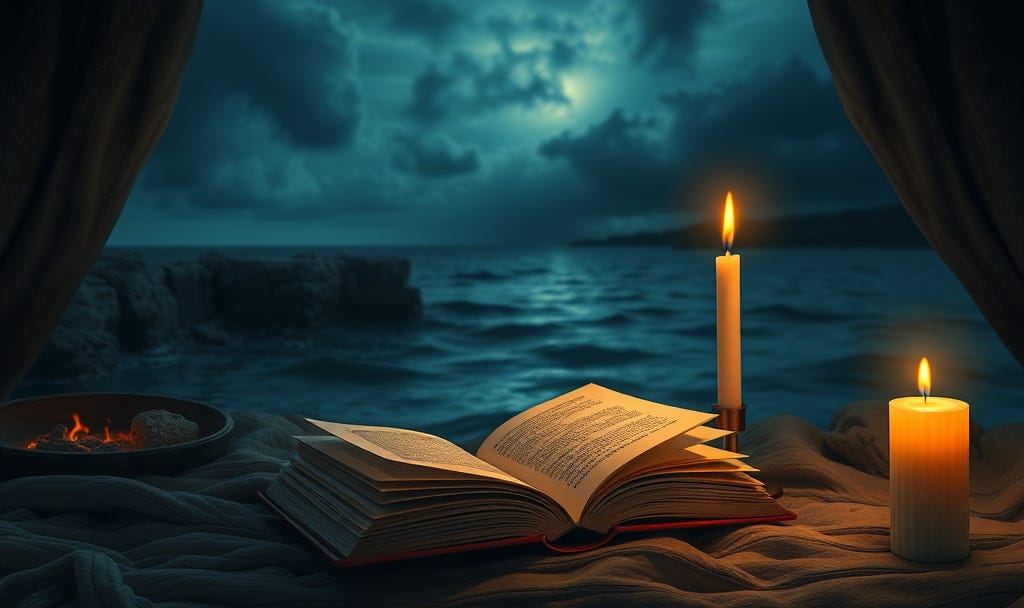
“Call me Ishmael.”
Ask anybody and they will give you the same answer as to what Herman Melville’s Moby Dick (or The Whale) is about: ‘Tis an 1800s nautical novel about Captain Ahab, the guy who lost his leg to Moby Dick, a big ole’ white whale. Ahab is obsessive in his quest for revenge against the whale for taking his leg. He sails across oceans to hunt down Moby Dick and fails, losing his ship, crew, and life. The moral is:
“Revenge can eat you up from the inside out.”
This book is a cautionary tale about not letting a need for vengeance consume your life. Somebody might mention the two Star Trek tales (the superb Wrath of Khan and the excellent First Contact) which directly reference Melville’s story in the context of Ahab’s mad pursuit of retribution. The end.
This is the answer I, too, would have given prior to reading the book. Now, however, I can tell you that this understanding, ingrained in the general culture’s mind, is wrong.
Yes, “Old Thunder” is a nutty captain on a doomed quest to kill the titular white whale, and the crew of his whaling vessel, the Pequod, does eventually realize that Ahab’s quest is foolhardy and is going to get them all killed.
But contrary to what mainstream media and culture says, Melville’s novel is not so simplistic as “revenge is bad.” Moby Dick is not about revenge at all. The gen-u-ine classic I fell in love with is about truths far greater than we were led to believe.
One night, I could not sleep, and found an audiobook of the late great book narrator, Frank Muller, whose majesty I first knew from his reading of The Dark Tower books, giving his take on Moby Dick. I figured the old-timey book would be filled with fanciful, impossible-to-follow talk and swiftly lull me to sleep. Yet, just as Muller’s perfect narration began to send me to the Land of Nod, passages in the first chapter began to stir my heart and imagination in a way I did not expect. Hooked, I began reading the book, and soon I realized that what Melville had written was not a book trapped in its mid-19th century era.
Melville really had written a story about a timeless theme: humanity’s vain hope that we can ever match—let alone defeat—powers greater than we can imagine, and why, to our detriment, we fight the fact that we are specks in an unstoppable universe neither benevolent nor malicious.
“We Ourselves See in All Rivers and Oceans.”
Moby Dick is a first-person narrative written by the protagonist, Ishamel, chronicling his time on the Pequod’s whaling voyage long after the ship has sunk. (He tells the reader this doom early in the book). What captured my attention is the fact that Ishamel says whenever he becomes restless, he takes a journey out to sea. He says all humans have this innate longing for the sea. We like to swim; be near water; every path we take leads us to water unconsciously; a painting of a lush countryside means less than one with a body of water.
Whether by some spiritual link we are ignorant of, our evolutionary ancestry longing to return to whence we came, some combination of both, or an unknowable answer, humanity’s heart is drawn to the sea. In a way, we believe we belong there. By the time I read this book, I realized, despite being a desert child, I, too, had an odd, serious fascination and longing for the ocean. Indeed, I have always fancied nautical stories thanks to reading Paul Dowswell’s Powder Monkey in 2nd grade. Swiftly, Moby Dick spoke to me personally.
Following the typical structuring of an Epic, Ishmael’s story just to get aboard the Pequod is long and tediously detailed, but Melville certainly builds up the hype for the voyage to start. The excitement at getting out to sea becomes overwhelming until, at last, the Pequod sets sail on a 3-year journey from the isle of Nantucket in the northern Atlantic. The whaling crew’s job: hunt, kill, and extract from whales as much organic goods—primarily oil for lamps—as they can. Already, there is a subtle socio-economics conversation in Moby Dick, as Ishamel says whalers are not highly regarded by the public due to their vicious jobs and perceptively unkempt ways, yet they literally help light the world against the darkness. The cost of said light is the slaughter of nature’s mysterious and mighty oceanic being.
But no time for real thinking about capitalism and nature! The adventure is underway, and we are finally at sea, humanity’s spiritual playground! Melville’s writing is so masterful there are many times I genuinely felt I was aboard the Pequod myself. Then, just as Ishmael and company settle into a groove, Captain Ahab finally enters the story, and everything changes.
“Unless God . . . Does that Living, and Not I.”
Once the Pequod is far enough away from Nantucket, Ahab reveals to his crew that he is going against his employers orders and they will primarily be hunting for the legendary Moby Dick, the white whale. Pumping up the sailors with his speech, Ahab persuades his crew that this quest is not crazy or vain, but will bring them great glory, for no sailor has ever defeated the gargantuan beast. Despite the trouble this mission will bring them, (for while they will still be gathering whale oil, this hunt goes against their legally binding contracts), the whole crew falls for Ahab’s rhetoric and happily imagines a future where they have slain Moby Dick.
The truth is, against my better judgement, so did I.
For Ahab, a married man with children back on land, is not actually obsessed with killing a specific whale for biting off his leg during a prior voyage. A limb is just a limb, despite his peg leg problems. Instead, we find out that Ahab sees in the white whale a symbol, an icon, a manifestation of the unfairness in the world that cannot be stopped. The impossible heights we cannot ever reach no matter how hard we try, so declares a silent and unkind universe. In a just world, he should be able to challenge the whale fairly, man to beast—a fin for a leg; trauma for trauma. In Ahab’s mind, there should be a balance of justice, a chance at a fair trial of might and wills. Instead, Moby Dick simply exists arbitrarily as something no one can ever stop, haunting the waters, proclaiming that there are some pains that will never be healed; triumphs that can never be reached; just because.
So often, we are told that there is always a choice to make things right. Always a way to make our lives better. That misfortune and injustice will not triumph in the end. Well. I have slept in a car without a home; been rejected for jobs so basic a monkey could do them and for no real reason; been denied the chance to live in better situations by the unnatural invention that is credit scores; have pounded my head time and time again against metaphorical walls only to find that while others have easily cracked these bricks, as we all hear about in the media, I, though just like them, doing the exact same thing they did, have only a bloody skull to show for my pain and effort. Just because.
As one can imagine, Ahab’s torment and determination to prove just this once that the little nobody can defy the universe struck me so deeply that Melville’s writing frightened me. How could a book from almost 200 years ago seemingly be writing about the socio-economic, spiritual struggles I and countless others deal with right now? Thus, though I knew the Pequod and Ahab’s fate, I could not help but wonder, too, about this theoretical future where that unnatural, uncompromising thing could be slain. Maybe then I, too, could have a fair chance in this modern world, filled with forces I can never beat . . .
“There is a Wisdom that is Woe; but There is a Woe that is Madness.”
Though there is plenty of nautical adventure and psycho-drama to be had in this tale, and many underlying conversations about humanity’s economic, spiritual, and existential prisons in this world, Melville dedicates so much, probably far too much, of the book to boring, academic journal-grade scientific essays on just what the heck whales are. Yet, despite the frustrating nature of these chapters, there is a method to Melville’s madness.
At first, the whale is characterized, and fixed in the reader’s imagination, as a beast more out of a mythical eldritch dimension than, ya know, an ordinary animal you can see at an aquarium. You start to buy into the idea that the whales are alien creatures and Moby Dick, with its unnatural whiteness, is the king of these inhuman kaiju. For how else could nature create such a thing humans cannot fully understand, if we are supposedly the inheritors of the Earth? After all, as the first chapter declares, we long for the ocean, and this realm we sail upon every day should be ours. If we belong there, nature should accommodate us, not threaten our destruction by such colossal beasts. Accounts from other ships about Moby Dick, revealing how the white whale swiftly comes and destroys anyone in its path like a terrible storm, exacerbates this interpretation.
If these words or our mission at One Brilliant Arc resonates with you, please consider buying us a coffee so we can continue helping creatives tell stories that can change the world. 🖤
Yet, when the Pequod starts making their kills of common whales, ripping their corpses apart for their precious oil with cold-blooded methodology, this mystic fades away. Yes, in the context of the book, the whale is the herald for how little we humans really are in this world, and how there are some things we just cannot ever stop. But as the reader sees the whale more like a living, breathing part of nature, the prior disdain dims. Unlike the rose-tinted interpretation of that first chapter, Ishamel and I started seeing the ocean, and all it represents for humanity’s spirit, as something much more complex; a place we can only hope to witness, never be a part of, for we do not belong in the land of whales and all their meaning. I, too, had seen Moby Dick as some unnatural predator, but as the story went on, I began to wonder if, despite what it symbolizes, Ahab would be better off accepting defeat of what he cannot change.
Maybe Moby Dick just is, and we just are, and that is that.
“. . . Only Found Another Orphan.”
At long, long last, the white whale is found at the very end of Melville’s perfectly dreamy novel. Immediately when I saw this white whale so perfectly in my mind’s eye, once believed to be a monster, an enemy of humanity’s struggle to be soulfully free in this world, I simply remarked:
“It’s beautiful.”
Moby Dick is, more or less, a god, and I realized that Ahab’s quest was absurd. Nothing could kill this god. The whale, though reminding me of every cruel laugh made at my expense by my socio-economic wardens in this life, was just a whale, and should not be disturbed.
The truth is, Ahab knows so, too. He is not as foolish as the crew may think. He knows Moby Dick cannot be killed; that what the animal represents in his mind cannot be defeated; that he will die, and he does not want to. But when humanity is told they cannot ever travel in space faster than light, millions of scientists around the world daydream and hypothesize how to make FTL drives anyway. The same goes for Ahab’s hunt for the white whale. People cannot help themselves but to try and face the impossible, for good and for ill, because they cannot stand their personal prisons; cannot accept that sometimes we are just little nothings in a universe too big for us.
Thus, the novel ends exactly as you would expect, and Melville’s 1851 book left me in 2024 with facts of life to ponder, and ponder, and ponder . . .
“Go the Distance”.
So, no, Moby Dick is not about how revenge is bad, represented by a nut with a peg leg and a hatred for a disobedient whale. Yet this example of mistaken theme is nothing new.
Another example of the deeper theme being sadly lost in the cultural zeitgeist is 1976’s Rocky. Commonly, the film is summarized as an underdog story in which Rocky Balboa, a scrappy nobody, heroically trains to fight a boxing opponent he cannot win against and triumphs, proving dreams come true. However, when one actually watches the film, Rocky is a romance story of self-redemption; a real and cathartic drama about how and why people give up on themselves and the agonizing struggle to regain the self-belief stolen from you. That you are more than just a failed loser. (Golly, what a life-saving film for me).
We all have our own interpretations of story themes that define the general consensus (those of you who watch OBA’s “Let’s Talk Stories” podcast have heard ours about The Lion King). Stories themselves often contradict the themes applied and assigned to them. What is terrific is that finding different themes within stories leads to different avenues of imagination that are all yours to be inspired from and use as creative fuel. Before, maybe you ignored Moby Dick as a boring revenge allegory—there are millions of them. Now, maybe you see Melville’s book as an example of how to take a subject (nautical adventure) and fuse it with timeless existentialism.
If you feel there are no more themes to explore that have not already been perfectly said by your favorite tales, first, know that you have a spin on these themes that matter and are inherently original by just being yourself. Then, seek out the unpopular themes in stories. Fresh perspectives that have gotten lost in the general conversation and pop culture summaries. Imagine what new insights you can gain and how these forgotten themes can enhance your dramas, your monsters, and your adventures. These unpopular thematic waters go deeper than we can know. What new and great stories are yet to be discovered!
Got a story in the works that you need help drawing a deeper theme out of? OBA’s story team is here for you! Submit your work in progress for a FREE editing session with our panel of story coaches!
💬 Comment below:
Have you ever read Moby Dick?
What story surprised you with a theme that was deeper than you expected?
Moby Dick is an incredible book. The whale obviously drives the plot but there's so much more going on. Melville deals a lot in contrast/paradox and I guess the book as a whole is like that in that a lot of it is abstract and philosophical but then the whale hunting scenes are very physical and action-packed.
This is one of my favorite passages: "Consider the subtleness of the sea; how its most dreaded creatures glide under water, unapparent for the most part, and treacherously hidden beneath the loveliest tints of azure. Consider also the devilish brilliance and beauty of many of its most remorseless tribes, as the dainty embellished shape of many species of sharks. Consider, once more, the universal cannibalism of the sea; all whose creatures prey upon each other, carrying on eternal war since the world began. Consider all this; and then turn to the green, gentle, and most docile earth; consider them both, the sea and the land; and do you not find a strange analogy to something in yourself?"
And this as well: "To enjoy bodily warmth, some small part of you must be cold, for there is no quality in this world that is not what it is merely by contrast. Nothing exists in itself."
Lots of humor too. "I’d strike the sun if it insulted me."!