

The Stars Don’t Have to Align
Stop waiting for life to cooperate to work toward your dream


“Life Happens Wherever You Are.”
Whenever I hear the phrase,
“The stars aligned,”
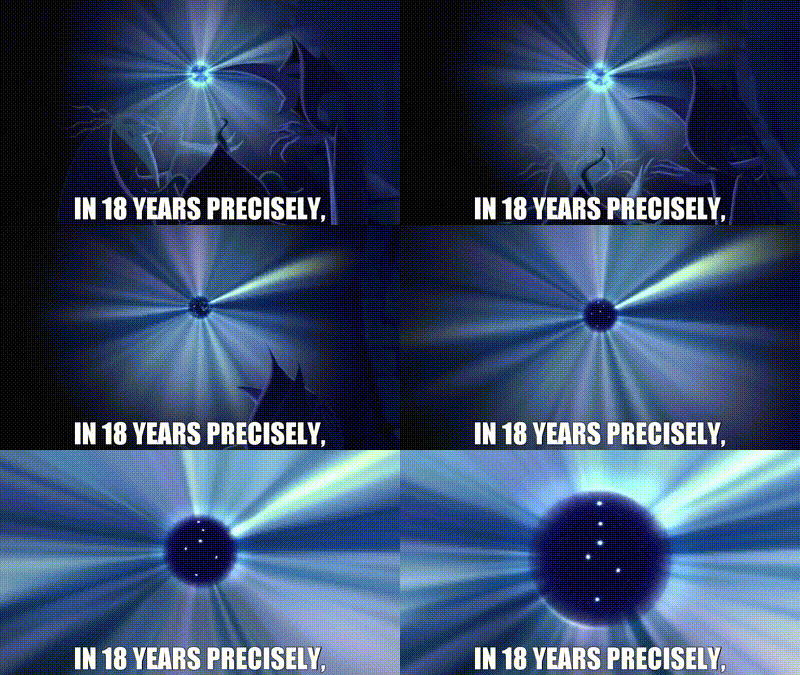
I always think of Disney’s Hercules, and how the villainous Hades needed to have the solar system planets align for his master plan of conquering Olympus to succeed. Of course, we all know how that dastardly scheme turned out.
Recently, with my own Cosmos project underway (shameless self-promotion here), I got to thinking of the dreaded task that inevitably binds any project, big or small. Something Hades’ scheme was dependent upon.
Scheduling.
Golly, lining up every tiny and major detail that needs analyzing, breaking down, and executing for any project, but particularly a life’s work like this one, just fricking sucks. The tedious paperwork is always tedious paperwork, but there is an added pressure to get everything just right, timing and all, lest the project flop. In other words, I have become a bit like Hades: waiting for the planets to align to launch my master plan, all while setting in motion several smaller plans to make the big one work in the end. Juggling all the scheduling to perfect the timing, waiting for the stars to align and trying to make the planets do so, or else I get nothing in return for decades of pouring my soul into this work.
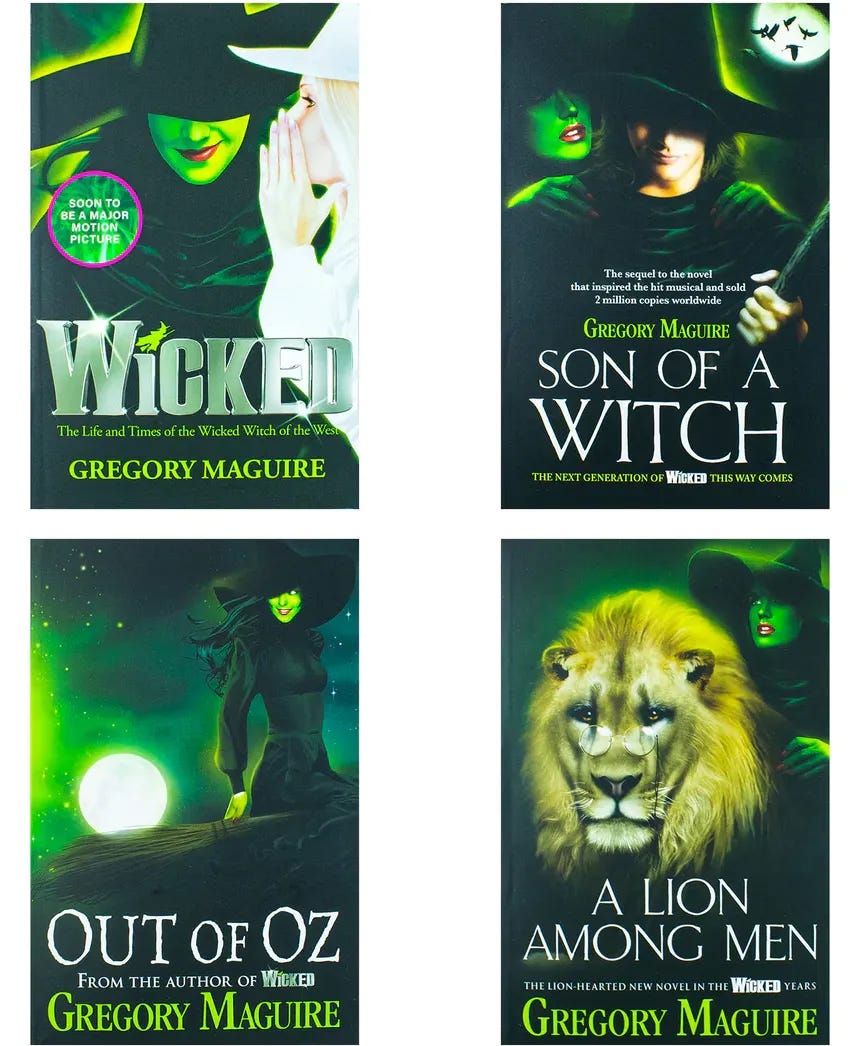
But this dread was interrupted by my train of thought arriving at another fantasy: Gregory Maguire’s The Wicked Years books.
“Life Is What Happens When You Are Making Other Plans.”
In Wicked: The Life and Times of the Wicked Witch of the West, Maguire structures his book into two strange halves. The first is the origins—early childhood and college youth—of Elphaba Thropp, the future Wicked Witch of the West in the land of Oz. A chart of her journey to becoming the iconic villain and, most important, the explanation of why. In this first part, she joins a rebel group against the tyrannical Wizard of Oz and winds up having a romantic affair with Prince Fiyero; already her plans are going awry. But when the rebel’s plot fails and Fiyero is found by authorities and killed, the book takes a weird turn.
The second half of Maguire’s Wicked concerns Elphaba . . . well, to be honest, kind of getting dragged around by life. She has a little boy to take care of now (whether he be she and Fiyero’s son is a major question) and she performs this task poorly. Yet, she travels to Fiyero’s family castle of Kiamo Ko to also take care of his wife and children as a kind of atonement for her adultery and being the cause of her lover’s death. Other details come into play: Elphaba learns to fly, obsesses over a book of spells called the Grimoire, and other little plot threads converge that lead her to fulfill her ultimate MGM film destiny.
While enjoyable, when I read and fell for the book in college, I remember thinking about the second half:
“What happened to the point of the book, the Witch fighting the Wizard?”
Conventional storytelling advice dictates that the main character must actively drive the plot in service to one main goal, not be dragged aimlessly by every distracting plot thread to weaken the core story structure.
Maguire’s book denies such satisfaction and becomes more like life: wading through the years, trying to complete one task, getting distracted by another urgent one, and the stars never align.
Yet, as The Wicked Years go on, the truth turns out that while Elphaba may never have gotten her metaphorical planets to line up into one column in the end, she still undeniably left her mark on Oz.
If these words or our mission at One Brilliant Arc resonates with you, please consider buying our team a coffee so we can continue helping marginalized creatives find their voices and tell stories that can save the world.
In the second book, Son of a Witch, the coming-of-age tale about Elphaba’s adopted boy, Liir, this meandering through life instead of, ya know, COMMITTING TO A PLOT, is even more extreme. Liir’s initial objective in the book: find his missing sister. For a bit, he slowly tracks her down in the Emerald City . . . until he learns to fly. Oh, my goodness, what a powerful moment! Surely, Liir’s life will change for the better!
Instead, Liir reaches a dead end. He has nowhere to go because, in reality, flying once means very little to his hungry stomach, his parched throat, his penniless pockets, his abject loneliness, and other burdens on his shoulders. So, he joins the army for a while, which turns out very badly for him, before committing to more meandering, almost getting killed, then more meandering, until Maguire finally gives him a more classical purpose to commit to. By this time, though, the book only has about fifty-or-so pages left and the boy has become a man.
Suffice to say, the stars never align in Liir’s story, either.
But, like Elphaba, the path Liir’s life took him on led him to change Oz like a wicked son of a witch, regardless of what any planet had to say.
This book that defied conventional plot structure is powerful because Maguire understands that life never turns out the way your schedule ordered. You can feel like you are getting tossed around aimlessly for years on end, yet that does not mean that a great tale is not unfolding.
“Perfection and Power Are Overrated.”
In reality, stories are filled with characters whose stars never align. Their plans go belly up, get sidetracked, or never quite come together. The outcome of the “The Crossroads of Destiny” or “The Day of Black Sun” episodes in Avatar: The Last Airbender. King Arthur’s great hope to turn might for right in T. H. White’s The Once and Future King. The anti-climactic battle of The Hunger Games: Mockingjay. The list goes on and on.
These characters who live lives like us have many great purposes, and one of them is to tell us a very important message:
One does need their stars aligned to live a memorable life.
Life is good, life is bad, plans succeed in ways we do not expect them to, schedules shift, delays happen, plans utterly fail, losses pile on, fortune smiles, and a million other variables and outcomes play out in life no matter where the stars are. One should not wait for stars to align to finally get something right, because the Earth is still spinning on its own axis, forcing them to move, no matter how fast or slow, whether or not there is a heading they can understand.
In these early months of Cosmos’ production, I learned how Elphaba felt in her years at Kiamo Ko, and how Liir did, too, travelling aimlessly through Oz on his own. There is a self-frustration at failing to get things just right, to get all the planets lined up in a row to execute plans perfectly so that we can just get to the next frigging phase of life already. But life does not change its course for any planet. I had been so buried under my self-frustration and anxieties in the scheduling details that I didn’t realize until recently that great progress, however slow, HAS been made on my project. Just as Elphaba grew into the important legend of the Wicked Witch against the tyrants of Oz, just as Liir follows her path to greatness in his own way without things ever going according to their plans.
I did not need my stars to align to get my work accomplished. Nor do you. As Father sings in the closing number of the Stephen Schwartz musical, Children of Eden:
“No doom is written in the stars.”
Likewise, a creative’s life—like everyone else’s—does not operate on the schedule of the stars (or the algorithm), and that is okay. We may feel compelled to write like we’re running out of time, but that does not mean we are failures if we did not succeed yesterday.
Do not wait for the stars to align to work on your craft, because life is happening NOW. Do not feel terrible when the stars do not align, because they do not dictate your tale—YOU do.
Life is a much more present and interesting navigator, anyway.
💬 Join the conversation! Share with us below:
What creative project have you always dreamed of working on OR are still trying to finish?
Where have you been most tempted to wait until the stars align in your life to start moving toward your goals
This is where most internet writers would put a convincing-sounding “call to action” and direct you to click something, but we just want to offer you honest encouragment along your creative journey—no strings attached. Now get off social media and back to writing! 🖤
(Okay, but if you still need a brain break, feel free to check out Cosmos—seriously, we are SO PROUD and excited to be working on bringing this indie animated space opera adventure drama to life for you! The first character designs for our pilot episode were just dropped over the weekend! Check out all the BTS goodies by following @cosmos27 or @cosmosproductionteam on your favorite social media!)
Waiting for perfection is something I've done in the past a lot, and I don't want to think of the opportunities I've missed by waiting. Now I know that finish3d imperfect is better than a perfect nothing.