


Hey, we want to invite you to something cool we’re doing on July 18th. The OBA Story Team, along with Jessica Ann, are putting on a✨FREE✨ storytelling workshop to help you create more resonant protagonists! We would love to see you there! 🖤
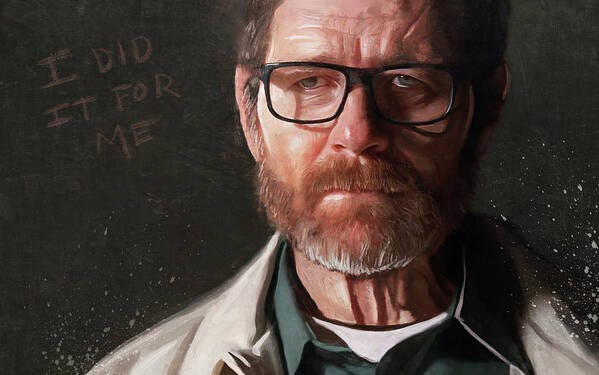
Think about the moment in Breaking Bad when Walter White finally admits,
“I did it for me.”
For five seasons, he fed himself the ultimate “Character Lie”:
I’m doing this for my family.
It was the shield he used to justify every murder, every lie, and every soul-crushing choice. When that lie finally shattered, the story’s climax hit us square in the chest.
But what happens when your protagonist’s journey feels…flat? You’ve got the explosions. You’ve got the snappy dialogue. You’ve got the high stakes. Yet, for some reason, the emotional payoff just isn’t hitting. The story is stuck. No matter how many times you rewrite the climax, it still feels like a hollow shell of what you envisioned.
At One Brilliant Arc, we’ve seen the consequences of a weak character arc thousands of times, whether from clients’ first drafts or pop culture media flops. The problem is not fixed by rearranging your plot. The real problem is a weak Character Lie: the false belief at the absolute center of your protagonist’s soul. If you skip the central Character Lie, you won’t have a solid foundation to build your protagonist’s character arc from. This problem will quietly sabotage your entire narrative structure if you do not fix it.
If your protagonist’s arc feels broken or lackluster, it is likely because they don’t have a strong enough lie they believe. Here is how to troubleshoot your protagonist’s core conflict and stress test if the lie your protagonist believes is strong enough. Fix your story’s character arc structure using the One Brilliant Arc Method!
1. The Lie Is Too Vague
A weak lie is the silent killer of great fiction. If you say your character is just “insecure” or “unhappy,” you haven’t dug deep enough. A true Character Lie is a specific, actionable, and deeply flawed worldview.
The Fix: Make your protagonist’s Character Lie a statement. Instead of “insecure,” try: “I am only worthy of love if I am the most successful person in the room.” Now that’s a worldview we can work with.
2. The Lie Is Not Rooted in a Visceral “Wound”
Why does your protagonist believe this lie? If there’s no backstory wound—a moment of trauma, betrayal, or failure that “proved” the lie to them—then the reader won’t buy it. The lie should feel like a survival strategy they adopted to keep from getting hurt again.
The Fix: Go back to the moment their world broke. Show us the scar that makes the lie feel like the only way to stay safe.
3. The Plot and the Lie are Running on Separate Tracks
This is the most common mistake for structurally stuck writers. If your protagonist’s external goal (winning the war, finding the treasure) doesn’t force them to confront their internal lie, your story’s arc is dead on arrival.
The Fix: Your plot should be a surgical tool designed specifically to cut out the character’s lie. If they believe “I can’t trust anyone to have my back when it matters most,” the only way to win the external conflict must be through an act of total vulnerability and trust when their neck is on the line.
4. The Lie Doesn’t Cause “Bad” Decisions
We love our characters, and especially when we understand their backstories so deeply, we can be afraid to let them be wrong. But if the lie your protagonist has built their worldview around doesn’t lead them to make mistakes, push people away, or blow things up, there’s no tension.
The Fix: Let the lie ruin things. Let it be the reason they lose the person they love or fail at a crucial moment. The more the lie hurts, the more powerful the eventual growth will feel.
5. You’re Missing the “Opposing Truth”
Every lie needs its antithesis. The “Truth” is the thematic heart of your story: the realization the character needs to have to become whole. Without a clear Truth, your character is just wandering in the dark without a map and your story is lost without a clear thematic direction.
The Fix: Identify the Truth early. If the Lie is, “I’m only valuable if I’m useful,” the Truth is, “My worth is inherent and independent of my productivity.”
6. The Transformation is a “Light Switch” Moment
Growth is exhausting. It’s messy. It’s a literal battle for the character’s soul. If your protagonist changes their entire worldview after one conversation, their positive character arc feels unearned, cheap, and shallow.
The Fix: Use the One Brilliant Arc Method to layer in “micro-shifts.” They should try to change, fail, retreat back to the safety of the lie, and then finally be pushed to the brink where they must choose between embracing or rejecting the Truth of your thematic statement.
7. The Climax Resolves the Plot, But Not the Character
If your hero defeats the villain but hasn’t fundamentally changed how they see the world, the ending will feel hollow. The climax should be the moment where the character has to choose between their old lie and the new truth to save the day.
The Fix: Make the internal victory the requirement for the external victory. They can’t kill the dragon until they stop believing they are a coward.
8. Your Protagonist Embodies the “Truth” Too Early
Sometimes we write characters who are too perfect. If your protagonist already understands the theme in Chapter 1, they have nowhere to go. Instead of going on an adventure that illustrates a character arc, they plateau and your plot has no reason to continue on.
The Fix: Dial back their wisdom. Give them more flaws. Let them be incredibly, frustratingly wrong at the start. Give the plot a purpose for existing.
9. There’s No “All is Lost” Moment for the Lie
To give up a lie, a character has to be shown that the lie no longer works. Their false worldview has to fail them completely. If the lie is still providing them with some level of comfort or success, they won’t let it go.
The Fix: Rip away the lie’s benefits. In your protagonist’s Dark Night of the Soul moment, when all hope is lost, the lie should be the very thing that caused their world to collapse.
10. You Have Too Many Lies
If your protagonist is trying to learn how to be brave, and how to trust, and how to be less selfish, and how to cook a better soufflé, the narrative impact gets diluted.
The Fix: Pick one core lie. One singular, devastating false belief that shapes everything. Focus all your thematic energy there.
How to Fix Your Plot: The One Brilliant Arc Method
Heartfelt storytellers know that identifying the Character Lie in your story isn’t just writing advice; it is soul work. Unpacking your character arc like this is the key to moving from endless revision cycles into a story that finally feels complete. At One Brilliant Arc, we also believe that this moment in your story development is exactly what transforms your draft from mere entertainment into a world-changing story.
The One Brilliant Arc Method is our unique framework for narrative diagnosis. Our editors don’t just look at where your commas go. We look at the emotional truth underneath your story’s structure. Whether you’re a novelist stuck in the “mushy middle” or a screenwriter whose protagonist feels like a cardboard cutout, we help you identify that core lie your character believes so you can build a story that hits harder and stays with your audience forever.
Stop spinning your wheels in the fog of writer’s block or narrative resistance. You have a story that the world needs to hear. Especially if you represent a voice that has been historically silenced or overlooked, your perspective is the medicine our world needs. But you can only deliver that healing medicine if your story is structurally sound.
Ready to apply this method to finish your book or screenplay in a way that feels honest and powerful?
Start by registering for the free, one hour workshop on July 18th (or catch the replay)!
The world is waiting for your story. Don’t let a weak Character Lie keep your manuscript hidden in a drawer for another year. Let’s build something brilliant together.
💬 Comment below:
Does your story’s main character arc center around a lie your protagonist believes?
What struggles have you run into when trying to develop character arcs?